Animify
If you have ever watched Your Name (Kimi no Na wa) and felt your breath catch at the sight of a comet streaking across a twilight sky, or been struck by the hyper-detailed Tokyo cityscapes in Weathering With You, you have experienced the unmistakable visual language of Makoto Shinkai. Over the past two decades, Shinkai has established himself as one of the most visually distinctive directors working in animation — not just in Japan, but anywhere in the world. His aesthetic is so recognizable that a single still frame, even without characters, can be identified as his work.
Understanding what makes the makoto shinkai art style unique is valuable for anyone using AI to create anime-style art. Whether you are applying a shinkai filter to transform a travel photo or experimenting with AI anime generators, knowing the visual vocabulary of this style helps you choose the right source photos and evaluate your results. This guide unpacks every element of the your name anime aesthetic — from his treatment of light to his obsession with skies — and explains how modern AI captures and sometimes transforms these signatures.
The Visual DNA of Makoto Shinkai: Five Defining Elements
1. The Sky Is Always the Star
If there is one element that defines Shinkai's visual identity above all others, it is his treatment of the sky. In a Shinkai film, the sky is never just a backdrop — it is an active participant in the emotional narrative. Clouds are rendered in extraordinary volumetric detail, with individual formations catching light in ways that feel simultaneously hyper-real and impossibly beautiful. Sunsets explode across the frame in layered bands of orange, magenta, lavender, and deep blue. The Milky Way stretches across night scenes like spilled diamonds.
This sky-centric approach traces back to Shinkai's early career. Before directing feature films, he worked as a graphic designer and created his breakout short Voices of a Distant Star almost entirely alone on a Power Mac G4. Without a large animation team, he focused on what he could render beautifully as a solo creator — and what he could render beautifully was skies. The technique became his signature, and as his budgets grew, the skies only became more spectacular.
Shinkai's sky treatment goes beyond mere decoration. In Your Name, the twilight sky during the kataware-doki sequence — that magical moment between day and night — becomes the literal bridge between two timelines. In Weathering With You, the sky is both antagonist and sanctuary: the relentless rain that floods Tokyo and the brief, transcendent pockets of sunlight that Hina conjures. The sky carries narrative weight, emotional symbolism, and visual spectacle all at once.
For AI-generated Shinkai-style art, this means sky-heavy photos produce the most dramatic results. A landscape where the sky occupies at least 40 percent of the frame gives the AI the canvas it needs to apply the Shinkai cloud-and-light treatment. Our photo-to-anime converter guide covers photo selection in more detail.
 Layered cloud formations — the signature Shinkai sky treatment
2. Cinematic Lighting and Lens Effects
Shinkai's backgrounds often feel photographic rather than illustrated, and a big reason is his liberal use of optical phenomena that traditionally belong to camera lenses rather than paintbrushes. His scenes routinely include:
- Lens flare: Sunlight catching the "lens" and creating radiant, multi-pointed bursts of light that streak across the frame
- Bloom and light bleed: Bright areas spilling softly into adjacent darker regions, creating a dreamy, ethereal glow that softens the entire image
- Bokeh: Out-of-focus points of light rendered as soft, circular highlights — a technique borrowed directly from photography that adds depth and atmosphere
- Volumetric light rays: Visible beams of light, often called "god rays," streaming through clouds, windows, or tree canopies, giving the scene a cathedral-like reverence
- Chromatic aberration: Subtle color fringing at high-contrast edges, mimicking the imperfections of real camera optics and lending a subtle sense of realism to the heightened visuals
These lens-based effects create what film critics call "photorealism with emotional amplification." The world looks real — recognizably our world — but more beautiful, more luminous, more emotionally saturated than reality. This tension between the real and the heightened is the engine of Shinkai's emotional impact. It is why a simple shot of two characters standing on a hill at dusk can make audiences weep.
Shinkai's team at CoMix Wave Films employs a technique called "photorealistic background art" where artists paint over photographic references with meticulous attention to lighting physics. The result is environments that feel hyper-real while the characters remain recognizably anime-styled. This deliberate tension between character simplicity and background complexity is central to the cinematic anime style that has influenced a generation of animators.
3. Hyper-Detailed Urban and Natural Environments
Shinkai's backgrounds are almost absurdly detailed. In Your Name, the fictional town of Itomori is rendered with such specificity that viewers can count individual roof tiles on distant houses. In Weathering With You, Tokyo's Shinjuku district appears with such architectural fidelity that fans have created walking tours identifying specific real-world buildings, intersections, and even vending machines that appear in the film.
This commitment to environmental detail serves a narrative purpose. Shinkai's stories typically center on the relationship between individual human emotions and vast, indifferent natural or urban systems — a comet, a weather pattern, a sprawling city. By rendering these systems with exhaustive precision, he makes their scale felt viscerally. The environments are characters in their own right, carrying as much emotional weight as the protagonists.
When AI applies the shinkai filter to your photos, it amplifies environmental detail. A standard city-street photo gains enhanced reflections on wet pavement, more intricate window patterns, and atmospheric depth that mimics Shinkai's signature background painting technique. A landscape photo receives dramatic sky treatment and heightened color contrast between natural elements, transforming an ordinary snapshot into something that feels extracted from a Shinkai storyboard.
4. Color Contrast as Emotional Language
Shinkai employs color contrast more aggressively than almost any other anime director. His defining palette juxtaposes warm golden sunlight against cool blue shadows — the iconic "blue and gold" look that has become synonymous with his name. This is not subtle color grading; it is deliberate, stylized contrast designed to evoke specific emotional responses.
In Your Name, the rural scenes of Itomori are dominated by lush greens and warm earth tones, while Tokyo sequences lean into cool blues and harsh fluorescent whites. The comet sequences explode into purples and magentas. Each color environment communicates the characters' emotional states before a single line of dialogue is spoken. Mitsuha's rural world feels nostalgic, grounded, and slowly fading. Taki's urban Tokyo pulses with energy, isolation, and ambition. The color tells you everything.
This principle translates directly to AI style selection. Photos with existing warm/cool contrast — a sunset portrait, a city shot with both sunlight and shadow — give the Shinkai AI filter the best raw material. The AI detects and amplifies these existing color relationships, pushing warm tones toward gold and amber while deepening cool tones into rich blues and teals.
5. The Anime Character in a Photoreal World
One of the most distinctive aspects of Shinkai's visual identity is the deliberate tension between his photorealistic backgrounds and his more traditionally anime-styled characters. Unlike Hayao Miyazaki's Ghibli aesthetic, where characters and environments share a unified painterly texture, Shinkai places simplified, cel-shaded characters into nearly photoreal environments.
This creates a unique visual effect: the characters feel like real people navigating a world that is simultaneously recognizable and heightened. It mirrors the emotional experience of his stories — ordinary individuals caught up in extraordinary, world-altering events. The contrast between character simplicity and environmental complexity is not a budget limitation; it is a deliberate aesthetic choice that reinforces the core themes of his work: that even the most ordinary person can be the center of an extraordinary story.
How AI Captures and Transforms the Shinkai Style
When you apply a shinkai anime filter to your photo using an AI generator, here is what actually happens under the hood. The AI has been trained on a vast corpus of images, including anime frames that exhibit the visual signatures described above. The style prompt instructs the model to emphasize five key transformations:
- Volumetric clouds and dramatic sky rendering: The model allocates significant computational attention to sky regions, generating detailed cloud formations and atmospheric color gradients that mimic Shinkai's multi-layered painting technique
- Lens flare and light bloom effects: Bright regions in your source photo are detected and amplified, receiving the characteristic Shinkai glow through enhanced luminance and radial light scattering
- Enhanced color contrast: Warm tones are pushed warmer, cool tones pushed cooler, creating the blue-and-gold signature that defines the Shinkai aesthetic
- Background hyper-detail: Architectural and natural elements receive additional texture, edge refinement, and atmospheric depth that mirrors the photorealistic background painting of CoMix Wave Films
- Cinematic framing: The composition takes on a widescreen, theatrical quality with enhanced foreground-background separation and focal depth
Interestingly, the Shinkai style is one of the most "transformative" AI anime styles available — meaning the output can diverge significantly from the input in ways that are creative rather than merely filter-like. This makes it particularly exciting for landscape and cityscape photos, where the AI has large areas of environment to reinterpret. Portrait photos also work well, though the character-background contrast that defines Shinkai's films manifests differently in AI output: the subject retains more of their photographic origin while the background undergoes dramatic Shinkai-ification.
Best Photo Types for Shinkai-Style AI Transformation
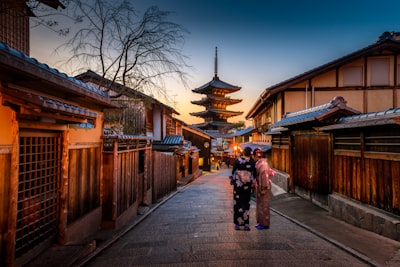
 Sunset landscapes with natural silhouettes produce the most dramatic Shinkai-style transformations
Golden Hour Portraits
Photos taken during the hour after sunrise or before sunset align perfectly with Shinkai's warm/cool color philosophy. The natural golden light on the subject's face combined with blue-shadow backgrounds gives the AI everything it needs to produce a convincing Shinkai transformation. The result often looks like a theatrical poster for a Shinkai film that does not exist — and that is exactly the appeal. For best results, position the subject so natural light falls across their face at an angle, creating the warm highlight and cool shadow interplay that Shinkai's colorists meticulously craft.
Cityscapes and Urban Photography
Shinkai is perhaps the greatest cinematic poet of Tokyo since Yasujiro Ozu. His urban scenes are detailed, atmospheric, and emotionally resonant. Street photography — especially shots with visible sky, reflective surfaces like wet pavement or glass buildings, and architectural depth — transforms beautifully. Night cityscapes with artificial lighting also work exceptionally well, as the AI enhances every light source with cinematic bloom effects and recreates the jewel-like quality of Shinkai's nighttime Tokyo.
Landscapes with Prominent Skies
As discussed, the sky is the star of Shinkai's visual language. Landscape photos where the sky occupies a significant portion of the frame produce the most dramatically Shinkai-esque transformations. Mountain vistas with cloud-wreathed peaks, coastal scenes with dramatic cloud formations, and open-field shots with expansive horizons all benefit from the AI's sky-enhancement capabilities. Photos taken during twilight — the kataware-doki that Shinkai himself celebrates — are especially magical when processed through the Shinkai style.
Couple and Relationship Photos
Shinkai's films are fundamentally about human connection — often romantic, sometimes familial, always emotionally charged. Photos of couples, friends, or family members, especially in outdoor settings, take on an emotional resonance through the Shinkai filter that other styles do not produce. The style inherently amplifies the emotional subtext of relationship photography, making it a popular choice for engagement announcements, anniversary posts, and family portraits. The visual language Shinkai developed — two figures small against an enormous sky, connected by an invisible thread of longing — translates directly to couple photography. Position yourselves with the sky behind you, and the AI will do the rest.
Shinkai vs. Ghibli vs. Cyberpunk: Choosing the Right Cinematic Style
If you are torn between styles, here is a detailed comparison of the three most cinematic options:
| Characteristic | Shinkai Style | Ghibli Style | Cyberpunk Style |
|---|---|---|---|
| Mood | Emotional, yearning, breathtaking | Warm, nostalgic, magical | Edgy, intense, futuristic |
| Lighting | Cinematic, lens-based, dramatic | Soft, natural, glowing | Neon, artificial, high-contrast |
| Colors | Blue-gold contrast, vivid skies | Earth tones, pastels, soft greens | Purple, cyan, magenta, deep black |
| Best Photo Types | Golden hour, cityscapes, skies | Nature, gardens, family portraits | Night shots, urban, tech-focused |
| Key Films | Your Name, Suzume | Spirited Away, Totoro | Akira, Ghost in the Shell |
Creative Applications for Shinkai-Style AI Art
Beyond personal enjoyment, Shinkai-style transformations have practical creative applications:
- Travel photography enhancement: Transform vacation photos into cinematic artwork that captures the emotional experience of a place, not just its visual facts. A photo of a Tokyo street becomes a frame from an unmade Shinkai film.
- Social media storytelling: Shinkai-style images naturally suggest narrative — each one looks like a still from a movie, which drives engagement on platforms like Instagram and TikTok. Our guide to AI anime art for social media covers platform-specific strategies.
- Couple and wedding content: The romantic, yearning quality of Shinkai's aesthetic makes it perfect for relationship photography, engagement announcements, and couple portraits.
- Album art and creative projects: The cinematic quality provides a professional, emotionally resonant look for music projects, book covers, and independent creative work.
- Fan art and community engagement: Anime fans immediately recognize and respond to the Shinkai aesthetic, making it an effective style for building community engagement around creative projects.
Technical Tips for Better Shinkai Transformations
To get the most out of your Shinkai-style AI transformations, keep these practical tips in mind. First, shoot or select photos with a 16:9 or similar widescreen aspect ratio — the Shinkai style feels most natural in cinematic proportions. Second, avoid busy foregrounds that obscure the background; Shinkai's visual language depends on the relationship between subject and environment. Third, if your photo has people, make sure they are looking toward the horizon or sky rather than directly at the camera — this creates the contemplative mood characteristic of Shinkai's character framing. Finally, photos with natural atmospheric elements — mist, rain, falling leaves, cherry blossoms — give the AI additional texture to work with and produce richer results.
Get the Shinkai Look for Your Photos
The Shinkai aesthetic taps into something universal — the feeling of standing under a vast sky and feeling simultaneously small and deeply connected to the world around you. His visual language translates that emotional experience into images, and AI now makes that language accessible to anyone with a smartphone.
Transform your photos with the Shinkai style on AnimifyAI's free generator. Upload a photo, select the Shinkai style, and in seconds you will see your image reimagined through the cinematic lens that made Your Name the highest-grossing anime film of its era. Three free transformations, no account required. For more style exploration, check out our guides to the cyberpunk anime aesthetic and the watercolor anime style.
Have a golden-hour photo with a dramatic sky? That is the Shinkai sweet spot. Drop it into the generator now and watch your ordinary sunset become a scene worthy of Your Name — no directing experience required, just a photo and 10 seconds.